The day started with a thought Selim recorded in Mosaic, and a feeling that the order he wanted had turned into its opposite.
sitting among the pieces
AI and cube design were supposed to bring order. Instead, he said, a lot is happening everywhere at once: in the database, the backend, the front end, different apps and environments, sessions, scheduled runs, threads, which to-dos are done and which can go, which design documents are still true. “It’s like I was trying to clean some dirt, but now I feel like I’m just sitting in a big hole and I don’t know how I can get out.”
He did not call the work wasted: “I learned a lot of new things … I found some pieces, but I also lost some other pieces on the way.” And he named what cube design does not promise: “when you find a new piece it’s really nice, but when you sit in the middle of lots of pieces which has no meaning and you don’t know how to put them together again”, then every key opens one more door. “That’s like an infinite loop.”
the screen inside the core
He did not start from everything; he narrowed it himself. “Let’s keep the part of the study for this project, just focus on that. Let’s not create chaos again.” A study read cube design’s own documents and placed every piece. About one line in four of the core spoke of an app, a screen, a tap or a phone, and 14 of 34 principles were rules for screens. Cube design was born on a screen, and the screen’s words had leaked into what should belong to no domain.
Selim had noticed the same shape applied again and again: the front end, the backend, the database, a company of agents, a way of thinking. That sameness is a cube one level up, and he named the new side himself: “it’s applications, you know, where the cube design is applied.”
0.5
He agreed to every recommendation at once and called it a breaking point: “we are making a 0.5 because this is a big change in the cube design.” Cube design now has a thin core, said only in pieces, cubes, parts and whoever looks, and six applications beside it: screens, front-end code, backend code, database, organisation and thinking. Seven principles were reworded without the screen, their old screen words kept. The message every agent wears now reads the core, then one application.
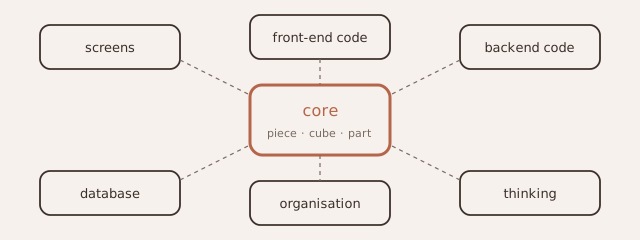
A thin core said in pieces, cubes and parts, and six places where it is applied.
“Delegate all that work to threads, whichever could work in parallel, and let’s get this chaos under control.” One thread moved the screens’ notebook (the studies, the persona tests, the regression cases, a thousand files with their whole history) into a repo of its own. Another did the reshaping. They agreed on who owned which folders before either moved a file.
less to read
Then Selim questioned a habit: “isn’t that already making a crowd and creating an overhead for the agents?” The frozen copies of the old versions were three times the size of the live text, and about two of every three search hits came from them. Git already keeps the history, so the copies went: each old version is now a tag, the website still builds them at the same addresses, and the old record is hidden from agents’ searches. The open questions left the one big record file too. Each now sits as one short line in the log of the place it is about, so an agent reading one application meets only its own.