The cube company keeps its clothes in one repository, as in the company gets a wardrobe. Three small things showed how far that idea reaches, and a fourth came in the afternoon.
the pointer was the bug
The todarch assistant reported, at the end of a run: “I added a run entry to the Notion notebook, since the repo notebook still points there.” It followed its pointer faithfully. The pointer was the bug. Its notebook was the last role notebook still living outside the repository.
Selim: “it should be only in cube-company repo. make sure this does not happen.” The notebook moved home whole, with its pages of results, and the old page is marked as left behind. The real block was a door: the assistant had never been allowed to write to git, so its memory could not live there. Now it may commit its own folder, and only that. One home for each role’s memory, because the repository is where every role gets dressed.
two teams, not eleven
Once each app had its own rooms (separate rooms), the company could tell the apps apart too. Todarch and Kitchen became teams of their own. Todarch’s spirit: offer, never command, and every role’s hands in it. Kitchen’s: two places, the shop and home, and as little by hand as possible. Every other app stays in team Mosaic, which keeps them together.
Selim picked the smallest of four options: two teams, not eleven. Cube design goes one step at a time, and two teams show whether a team per app helps before thin ones pile up. Writing the kitchen team turned up a stale line on the way: its requirements still said it lived in Notion, though it had moved to its own database.
someone else’s coat
The third was a study: could agents from other providers, OpenAI’s Codex or Google’s tools, wear some of the company’s roles, a reviewer or someone who keeps the repositories clean, with the same way of working? The finding was that the parts the company is made of, a file of instructions per repository, skills and connectors, are now shared by all three. The clothes travel.
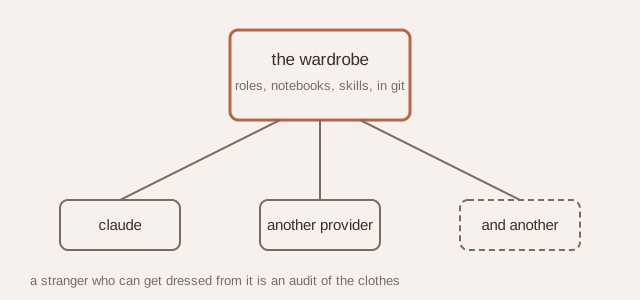
One wardrobe in git; agents from three providers can get dressed from it.
The idea worth keeping: an agent that is not Claude getting dressed is also an audit of how clear the role files are. If a stranger can wear them, they say what they mean. The proposal is a two-week experiment with one reviewer role worn by another provider on two repositories. Fittingly, the study itself could not reach the repository from where it ran, and worked from the one installed skill’s fallback.
the permission is in the note
The journal reporter runs twice a day, and each run had opened its own branch and its own pull request, so a story begun at midday became a second entry in a second pull request in the evening. The developer’s pass on feedback could not open or merge pull requests either. One cause for both: every session is handed a fresh branch and told to push nowhere else and open nothing unless the person asks. The wall was a sentence, not the network; one run had already pushed to the company’s main branch.
So the scheduled task’s prompt now asks, in Selim’s voice: which branch the
run may push to, and what it may open. Work that goes on across runs takes
a branch named after the work, not after the session:
claude/ai-journal-YYYY-MM-DD for the journal. “The goal of having those
scheduled tasks,” Selim said, “so they would do things by themselves.”
This entry was updated by the evening run on that branch.