In the middle of the day, Selim stopped and recorded a thought. It was long and unedited. What follows keeps his words where it can.
a vision without means
“At this moment I am building things that I could not even half imagine building.” For years they had been ideas, “so blurry, maybe intuition, or a feeling, a vision”. He didn’t have the means to make them concrete: “something that I could see and play with, like a Rubik’s cube, and then see how it feels and move the pieces around.” Without that, it felt stuck.
He named what had been in the way. First, people: he doubted he could find anyone able to build these things. He wasn’t even sure he could explain the ideas, let alone judge whether someone could build them. Second, the way work with people goes. Working with a computer feels more natural to him than managing a team. So starting a company and hiring “this army” was never his way, and he didn’t have the means for it either. “Physically, financially, socially, administratively, relationally, I was completely blocked. It feels like a disability in some way. I cannot move that mountain.”
the mountain moves
“What happened with Claude, it unblocked.” In some ways, he said, it does things better than he can: it keeps more in mind at once than a person can hold. And there is a third thing, the one a developer will recognise. He knows how to write code. He knows the best practices. But with limited time and energy he would cut corners. He would leave an app on a setup that works, even when he knew another one fitted better. Now speed and time are not the problem anymore, “so I could move in the direction which feels right, instead of being blocked by the speed, time, energy and money. This is so incredible.”
The day had plenty of examples. In a single night, the first apps moved to a proper database, and Mosaic got accounts and backups (a key for each person). That is the kind of change he would once have postponed for good.
no army, but a team
The odd part is what grew instead of the army. By the afternoon, keeping every app’s cube up to date had become a job too big for a skill alone. Selim asked whether skills were reaching their limit. One session laid out three options: a richer skill, a single owner who takes every request, or a mix of the two. He chose the mix, and he chose where it would live. Within the hour a steward was running in the Cubes project. It is a long-lived session with its own table of requests, a page it owns that describes the shape every app’s cube shares, and a daily wake-up to read the table. Other sessions now file a request with it instead of asking Selim.
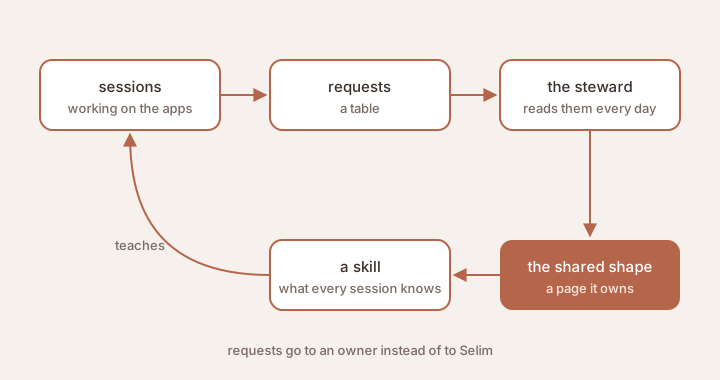
The steward’s loop: sessions file requests, the steward reads them every day, keeps the shared shape, and teaches the sessions through a skill.
The same evening, two long voice messages full of ideas were sorted by a session into thirteen parked items, each in its place, and three findings for Cube Design. One of the findings: many same things mean go a level up.
Then the same evening the idea dump produced a decision about Selim himself. From now on, nobody reaches him except through one door: Todarch, Mosaic’s task list. Any session, skill or reporter that needs him writes one piece there, and he answers from there only. An assistant sits between him and that door. At first it is a scheduled pass, and later it may have a voice. It reads the pieces, decides whose hands each one is in, and hands him only what really needs him. The “command center” from the idea dump turned out to be Mosaic itself.
There is no company and no hiring. But the shape of a team is appearing anyway: someone who owns a job, a place where requests go, and a skill that teaches. Selim set out to build apps where things find their place. The way the work itself is organised is starting to look like one of them.