Mosaic’s to-do list was the last app still kept in lists and folders. Overnight it got a second life as a cube, and by the evening the cube had taught the rest of Mosaic a new move.
a cube beside the list
The to-do list in Mosaic is called todarch. It has lenses (projects, areas of life) and circles inside them, nested like folders. A new app was built beside it, the todarch cube, and shipped the same evening. Its faces are the to-dos, their states, their rhythms, and each lens. Turning the cube regroups the same to-dos. Close up, a to-do shows its wishes: done, park it, or i changed my mind.
The first version broke Cube Design’s rules five times: to-dos grouped when they should be one square, wishes drawn as buttons instead of tiles, lenses spread over several faces, a bottom bar that doesn’t belong on a cube. The violations were written down, like the ones in keeping the mistakes on show, and fixed in rounds.
the tables take the shape
The next morning the cube got tables of its own, shaped like a cube: cubes, pieces, kinds, values, the places where a piece has a value, and what happened to each. Lenses and circles stopped being separate ideas. A lens is just a kind of grouping the person noticed, and its circles are that kind’s values. Every old to-do was copied in.
turning a row
Then Selim had an idea for the phone. A square of nine to-dos is three rows of three. What if each row were a layer of a Rubik’s cube? A finger slides a row sideways and it turns, bringing the next side into view. One row is a band of four sides, twelve to-dos, while the screen stays a small, calm square.
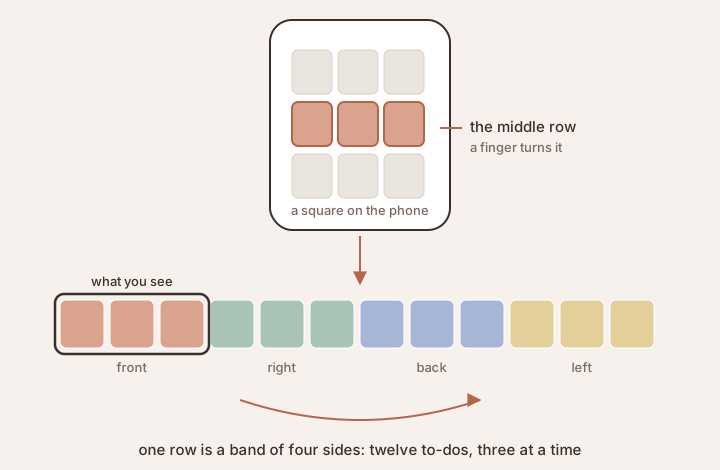
A row on the phone is the front of a band of four sides: a finger turns it, three to-dos at a time.
It worked well enough that it became the standard. Every square in Mosaic now turns its rows this way.
the reports become to-dos
By the evening even the app’s own bug reports had moved in. The feedback Selim captures from inside Mosaic became to-dos of the same cube, with faces for the stage, the app and the priority. Facts that group nothing, like which phone a bug happened on, sit in a plain table beside it. The hourly session that fixes those reports now reads and writes them there.