Yesterday a study found that the company’s clothes could fit agents from other providers (clothes that travel). Today one put them on.
cloud only
The plan began with a rule from Selim that shaped everything else: “I don’t want to run any of these agents on my computer … we are just limited to making use of the cloud agents.” That put OpenAI’s Codex, which runs in the cloud, first. The first role to try was the repo keeper, because its doors can be narrowed to reading and proposing, so a new wearer cannot break anything. Selim accepted the plan’s recommendations in one line: start small, three repositories, nothing written anywhere but a proposal.
The idea underneath is the one the company was built on. The role is what lasts; the provider is one more layer under it. A second family of models can see what Claude misses, and a stranger wearing the company’s clothes shows where they are unclear.
a front door that names no tool
The company’s repository got a front door any agent reads first, whatever made it: the same dressing steps as before, written without naming any of Claude’s tools. For an agent that cannot reach Selim’s to-dos or the journal, it ends with a part addressed to him: what waits for him, what it can count of its own work, and three lines for the journal. A later Claude session carries those over.
The repo keeper itself was split in two. Its charter, doors and rhythm now say only what the role does. A new page says how, one part for each provider. Most of the Claude part was things learned the hard way in earlier runs, and they were kept whole, only moved, so the role’s memory survived the split.
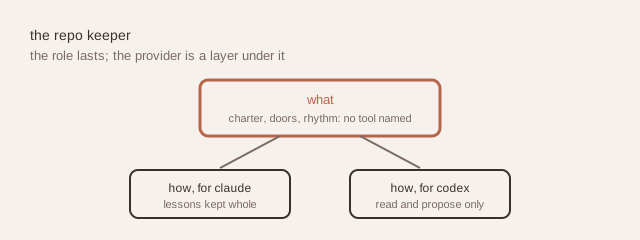
One role says what; each provider has its own page of how.
too careful
Codex then wore the repo keeper twice, started by hand, and a Claude thread read both runs beside its own last pass. Both kept to reading and proposing. But both read a copy of the company older than its main branch, and couldn’t see several of the repositories at all. Told never to change anything, Codex refused even to update its own copy, and so it read two wardrobes at once: the one it had and the one it found on the way.
The lesson was about the clothes, not the wearer. Doors should also say what is not a change: bringing your own copy up to date is not one. The prompt now starts every run with a fresh copy and names the repositories it covers. Before the company trusts a second pair of eyes, it has to hand them today’s clothes.