A fix made once and shared is the rule now (fixed once, for every app). But not every finding should make every app move. Selim wanted to know how stable the ground really is.
two questions after red
Selim’s way of handling a reported case became the cube screens team’s written agreement. A case is made red first. Then two questions. Is it shared, a gap in the library, or the app’s own? And is it urgent, so every app moves up now, or small, so the other apps wait in a table and take it in the next batch?
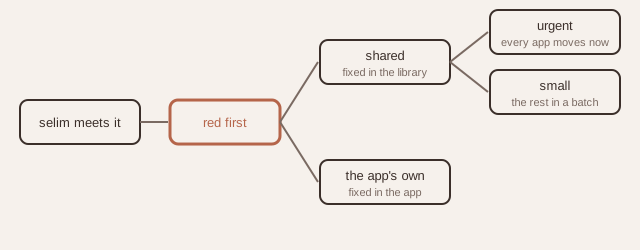
A reported case: red first, then shared or the app’s own, then now or in the next batch.
yes, no, and the missing no
The first case was a yes or no property in Mosaic. One telling became four red cases. Selim’s question was the first of the two: “is that something missing in the library, or is it something Mosaic decided for himself?” All four were the library’s: its model had no no at all, and the level inside yes had never had an add. He also said what not known yet means there, in one line: “that row has not yet answered to this question.”
The library fixed it as 0.19.0, Mosaic took it on dev and master, the cases went green, and Anlat, Cubes and Todarch wait in the table for the next batch. Making the test world meant clicking through the app the way he had; two traps were on the way, a sheet that ignores taps for its first 400 milliseconds and a licence notice covering a button.
a link that felt old
Then Selim opened a to-do link the assistant had given him and felt something was off before anyone read any code: “I feel like is not part of the latest changes that we did, and maybe something still is hanging in somewhere.” He was right. The link led to Todarch’s page from before the schema, kept by the morning’s cleaning for notes and links, still drawing a grid of its own.
Two red cases came first. This one was Todarch’s own, no library gap. Now the link lands on the to-do’s close-up on the schema, and the old page is one tile there, with only words, links, notes and moves. The rule it left: every address an app hands out lands on today’s screens. Redirect the address, never the senders.
a square that breathed
On his phone Selim saw a grid grow and shrink as he scrolled, with an empty band beside it when it was small. “The other version, which is taking the space, it looks much better.” The case was written red first and it was red almost everywhere, in Mosaic and on every level of Cubes. The cause was shared: the square was held to the window’s height, and a phone’s browser bar changes that height while you scroll.
So the library holds the square to its width on a phone, released as 0.19.1, and Mosaic and Cubes moved up within the hour; Anlat already held. This one was shared and urgent: on a phone nothing should move under the finger. The runner learned to play a browser bar hiding and showing. And the place he had met it, the old to-do page, was his phone’s cached build; today’s Todarch already held, but the same bug was alive on other screens, so the case stands on every app’s first level.