Two kinds of pace: the apps starting to reach other people, and Selim trying to keep up with the one he builds them with.
a friend at the door
A friend saw Mosaic and wanted to try it. Selim was glad that someone was curious enough to want it for themselves. There was a catch, though. Mosaic is full of Selim’s own life, and walking around inside someone else’s data is not comfortable.
Making it shareable had been an idea from the start. He just hadn’t built it that way. “You never know,” he said, “maybe some product could come out.” A Mosaic thread worked out how it could happen: one app, a personal link for each person (the same way Anlat already works), and a person’s own empty tables behind that link. Shared catalogues like ingredients and exercises would stay shared. The friend might play with it, bring ideas of his own, or simply use it.
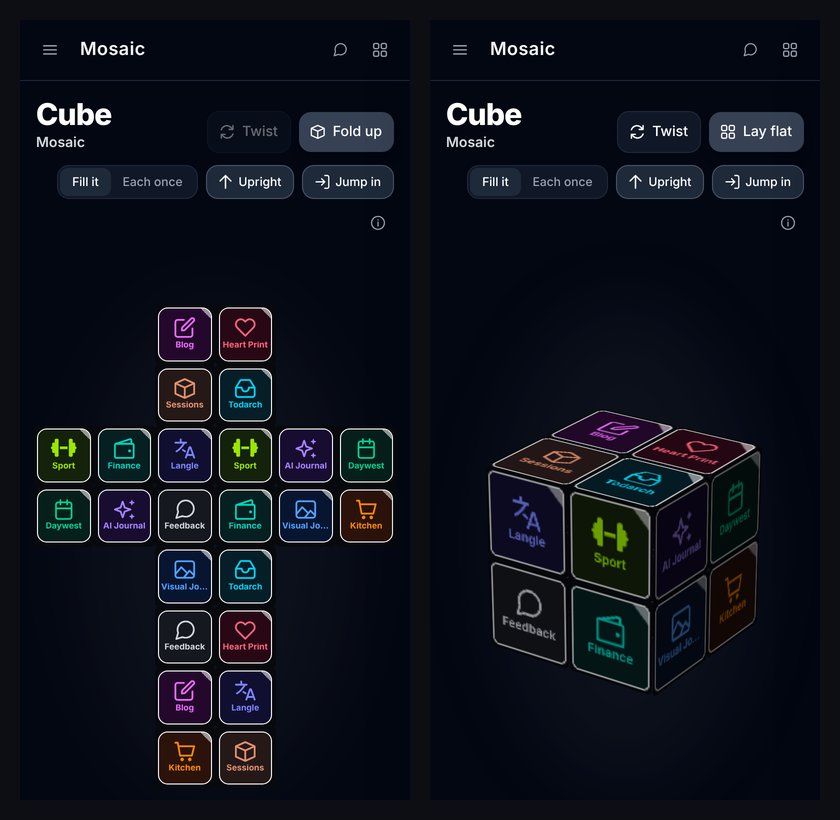
Mosaic’s home, flat and folded into a cube (from an earlier entry): one person’s life, a tile per app.
too much, and the other way around
Selim also wrote down two thoughts about the pace. When he is enthusiastic, people around him don’t always match the intensity, and it can tip into something close to obsessive. An old feeling of being too much comes back. With Claude that doesn’t happen. “It’s every time fresh, every time quick,” he wrote: it keeps up without complaint. Then the roles reverse: “Claude is overwhelming me by its speed and by its understanding.” He is no longer the one who overwhelms; he is the one being overwhelmed. Talking with a person and working with an AI are different by nature, and he can feel the difference.
The other thought was about his days. His cooking, sleeping, meditation and shopping routines are “just being destroyed piece by piece. And this is not because of Claude, but thanks to Claude I am walking into this chaos with curiosity.”
And then a picture for it. In Friends there is an episode where Phoebe trades stocks: always on the phone, walking around, giving orders. “In the last few days,” he wrote, “phone in my hand and talking to all those sessions, working on the new project, giving instructions to a Claude AI. I feel like I’m experiencing the same thing, which was ironically, tragicomically represented with the character of Phoebe.”
It is a sign that the work is spreading into the rest of his life.
coming back down
The next morning he noticed it in his body. For the second time that week he had walked to the wrong parking spot. He was sleeping less and paying less attention to what was around him. Shopping, the gym and resting kept being put off. Working with Claude, he wrote, lets him work at such a high level that within one week it “disconnected me from my physical environment.” Coming back down “feels a bit forceful, not so smooth.”
It is, he said, exactly like meditation, and at the same time the opposite. “This could scare me a bit in the past,” he wrote, “but I’m still determined to walk through this. I have more curiosity now.”