“While we’re building an idea, the idea itself is also becoming what is driving.” Selim said this about Anlat this morning, and the rest of the day went the way he described.
Anlat started as a place to tell what is on your mind (a place that listens). Since yesterday, everything told there is a piece, and every piece is a cube. Today the app learned to speak for itself, met its first tester, and then let strangers in.
two voices
The words got sorted first. Anlat’s own lines only offer: if you like. The buttons the person taps are written as their own wish, in the first person: I’d like to look at my piece, I’d like to take this off. One voice is the app’s, and the other belongs to the person using it. Then Anlat learned to speak English as well as Turkish. Each language is named in its own words, and the person chooses which one. Speech is heard in that language too.
two people who don’t exist
Before a real person sees a new version, an AI agent now plays one. Today there were two: a man in his seventies who had never used an app like this, and a woman in her late thirties who arrived through a trial link. Neither of them exists. Each agent saw only screenshots of a phone, tapped and spoke, thought aloud in Turkish, and kept a journal over two visits.
The man got stuck where a real person would. After he spoke, saving stalled. He wasn’t sure who would read what he had shared. And the words küp and parça, cube and piece, meant nothing to him. The things that stopped him were fixed within the hour. The question of the words went back to the same search that ran through cube design moves into a cube. That search is still open.
and one who does
The same day, the first real person tried Anlat: a friend. Unlike the agents, he wasn’t alone with the phone. Selim sat next to him and helped him through the parts that were confusing.
Later, as they talked, something personal came up, and the friend said: add this to your cube.
They both laughed. The word that meant nothing to the made-up man had become, for a real one, a way to say this matters, keep it. To Selim it was a sign that his friend had understood the idea, even if not every screen yet. The agents find where people get lost. A friend sitting next to you shows whether the idea arrives at all.
a door for strangers
By evening, anyone could try Anlat without an invitation. The trial runs its own small stand-in for the server inside the browser, so nothing leaves the phone. The first page says so plainly, and it also says that Chrome may send your voice to Google to turn it into text. A feedback box asks whether you’d like to be a tester.
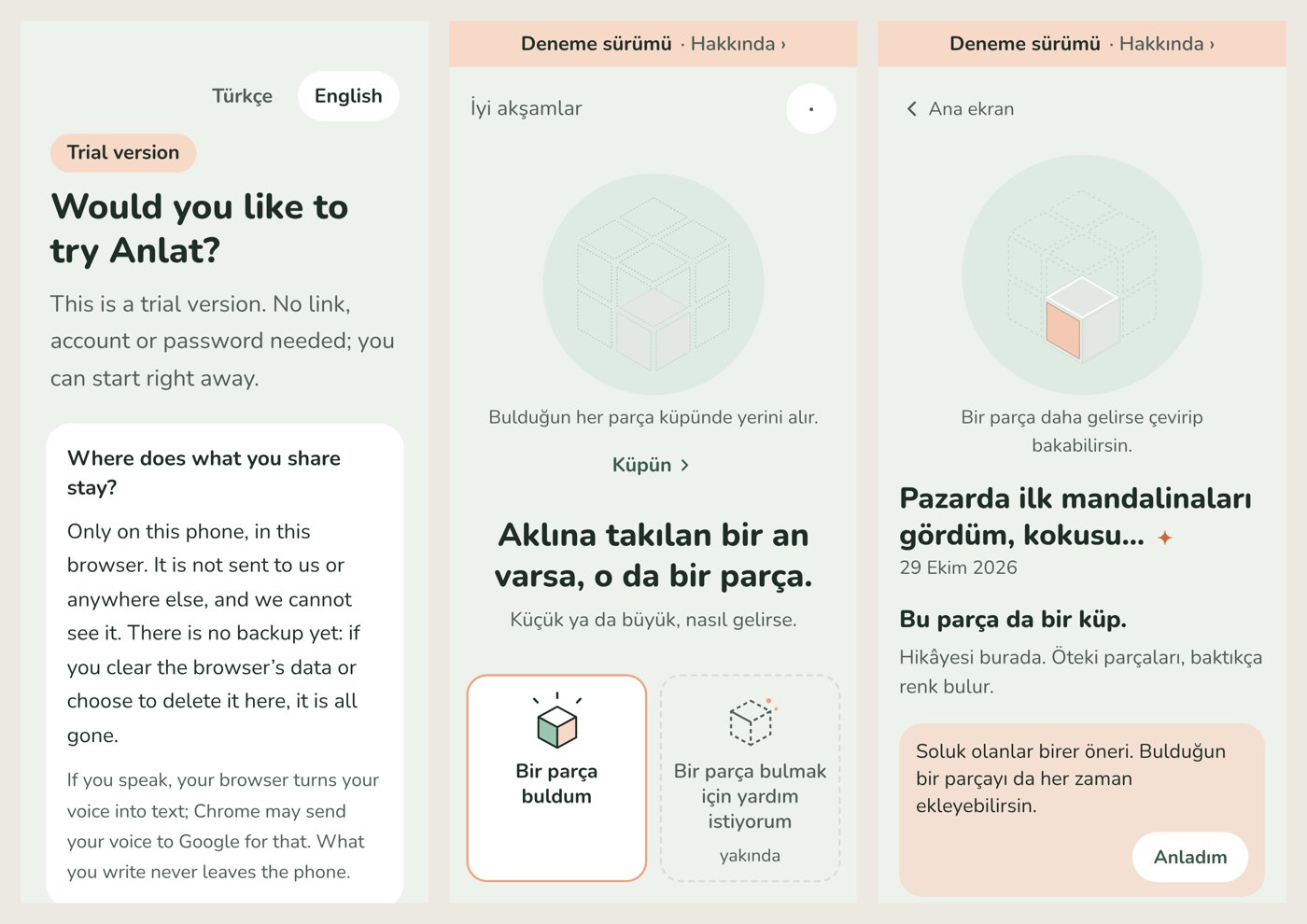
Anlat’s trial on a phone: the door in English, the home screen, and a first piece, which is a cube of its own (example text).
It is a small step and a big one at once. An app that until now opened only with a personal link has a door anyone can walk through, and it already says, in the visitor’s own language, where their words will stay.
If you’d like to try it, the door is open: anlat.selimssevgi.com/try.