“Cube Design now lives as a cube in the Cubes library. This is the craziest sentence so far in our journey.”
Yesterday the cube kept turning up in different rooms (the cube that kept showing up). Today it got a home of its own.
taken out of the apps
Early in the day, a Claude session read everything the three apps had made about the cube: the mock-ups, the concept notes, the journal entries. Then it wrote down what they share. That included a grammar, twelve principles and a few moves (zoom in, zoom out, turn). It also listed what each project is free to set for itself, and the questions nobody has answered yet. All of it went into a repository of its own, Cube Design, along with a skill that every agent working for Selim can load.
Within the hour, Mosaic and Anlat each got a small change named “Follow Cube Design”. The language had come out of the apps. Now the apps were pointing back at it.
the language keeps a log
Agents kept changing the design throughout the day, so the design needed somewhere to write down what changed. Every agent now records what it changed and why in a table, and Mosaic shows that table as a new tile. Selim keeps a change or leaves it with one tap. The same shape had already been used for this journal’s inbox (a newsroom with an inbox).
Even the agents’ memory got tested. Selim asked for a cube design skill, and the log showed one had already been written and never installed. Instead of building it again, the session found the old one and saved it.
and then it moved in
Then the design was written into Cubes as a cube in the public library. Its pieces include the principles, the words, the moves and the open questions, and most of them open into cubes of their own. That is when Selim wrote the sentence at the top. He went on: “And I am loving it. Because I don’t feel alone in understanding of that.”
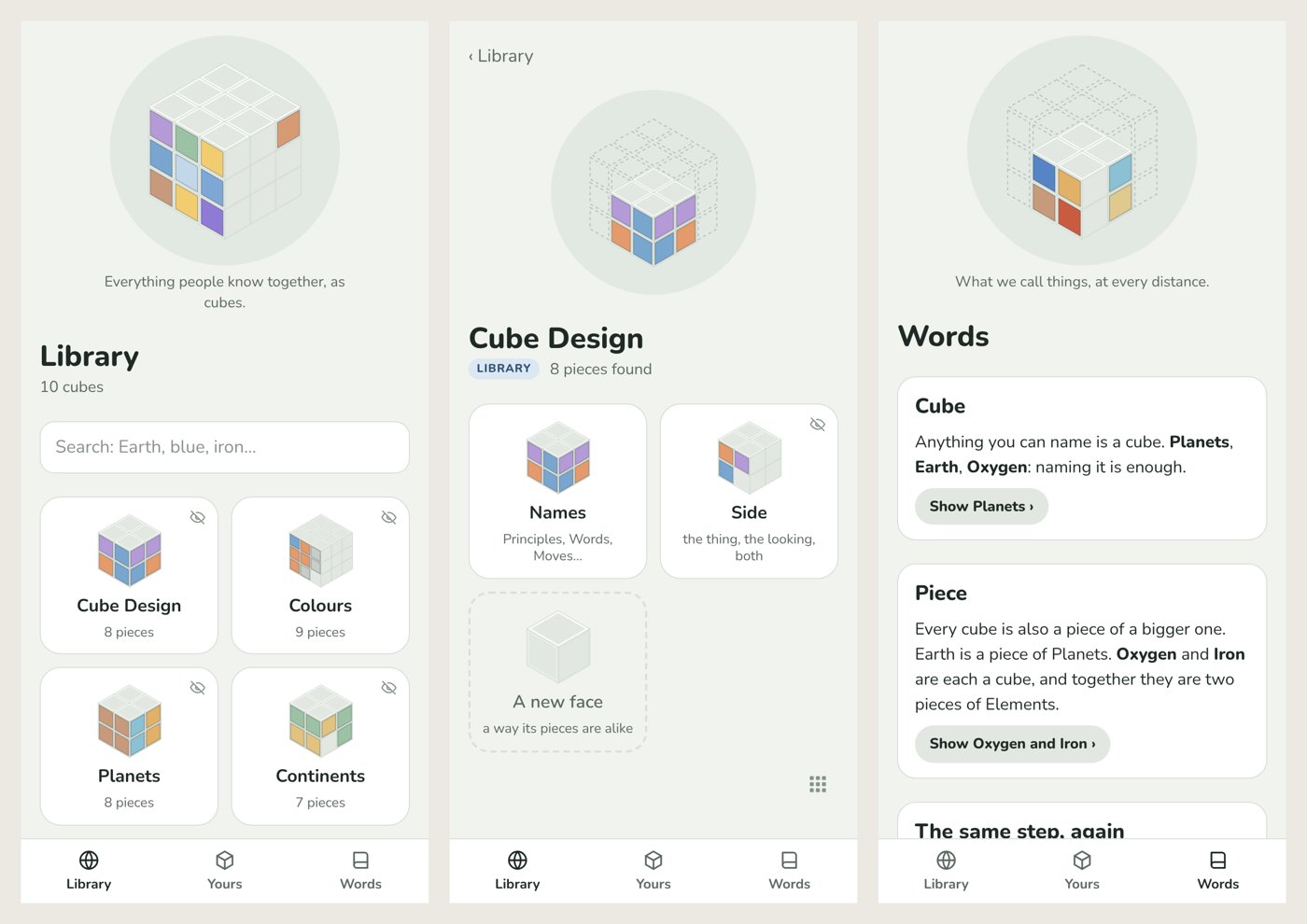
Cubes on a phone (mock data): the library with Cube Design in it, the Cube Design cube, and the Words tab.
looking for words
The rest of the day was spent on words. Selim gave three domains that name the same shape in their own way: a Rubik’s cube (cube, piece, face), a Notion table (row, column, option) and space (X, Y, Z). He asked for ten. The other seven came from the periodic table, field biology, linguistics, a library catalogue, a card game, machine learning and music. Each one was set against the cube’s still-unnamed parts. Then that comparison, too, became a cube.
One of his sentences, a cube is both a thing and a way of looking, was taken in as a question to study, not as a rule. Then he found a real knot. A university has many professors, and a professor can teach at many universities. A mountain can stand on two continents. Follow those links in Cubes and you can zoom in four times and come back to where you started. Anlat avoids the loop by having two ways in. Up close, a value is something you tap; the other side opens only from far away, across all your stories. It is now open question number twelve.
None of this is code yet. It is a vocabulary being tested in three apps at once, while the apps are being built. The apps are where the language gets tried out, and the design is where everything they learn gets collected.