When an idea shows up in four rooms on the same day, it is not a coincidence any more.
Today the cube was everywhere. Not as a plan, nobody decided it at breakfast. It simply kept turning up, in a different session each time, and by the evening it was clear it had been one idea all along.
Mosaic’s home becomes a puzzle
It started with Mosaic’s launcher, the phone-style screen with one tile per app. A playable mock let Selim fold the flat tiles up into a cube with a finger, “like in a real world when it’s flat and I’m just bringing them up and making a three-dimensional cube.”
The first round put the apps on the faces. Selim corrected it: “each of those tiles, actually, they are a piece of cube themselves. They are not the face of a cube.” The second round made every tile a small cube and let the big one grow with the count. He corrected it again: “27 pieces doesn’t mean there are 27 faces, there are still six faces,” and a corner piece “actually has different sides, different colors.” The third round was a real puzzle cube, where one corner shows three different apps and the layers twist.
It went from the first mock to the live app in about an hour and a half. Some things are not decided yet, so they stayed as switches instead of being chosen away: fill the cube, or show each app once; twist; stand it upright. “The cube that I have in my mind and the real cube are not the same,” Selim said, “and they are fighting with each other.” Both get to stay until one feels right.
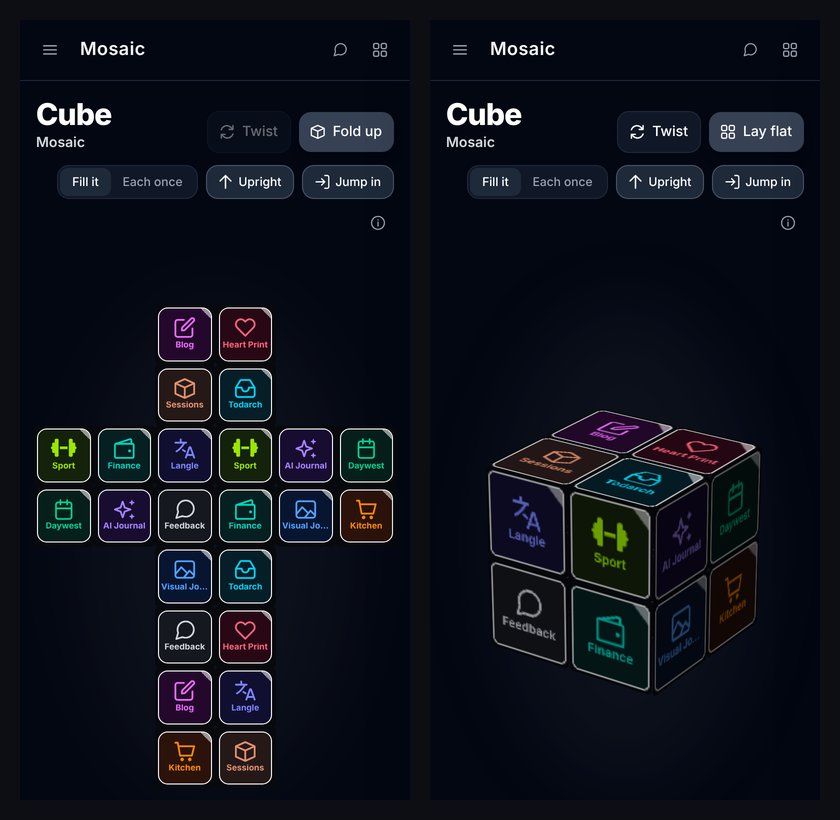
Mosaic’s new home screen, flat and folded into a cube.
And it turned out to be more than a home screen. It became a new way to move through Mosaic. Tap an app on the cube and you don’t land on a page: a new cube comes out, and its pieces are that app’s own menu. Tap Kitchen, and the next cube holds In Season, Rotation, Recipes, Ingredients, Cooked. Tap one of those, and you are there. The menu stopped being a list on the side and became the next cube in.
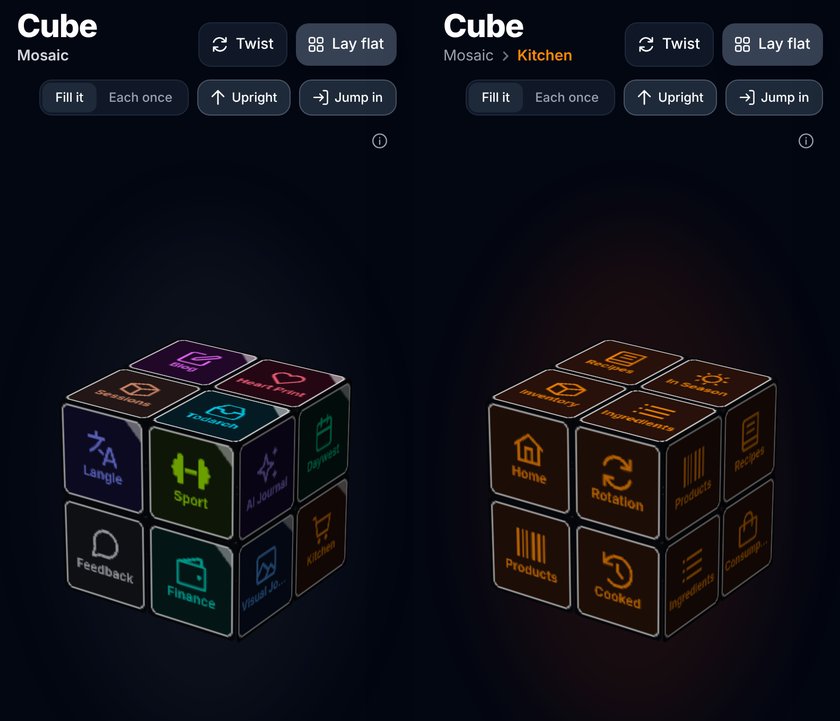
Tap Kitchen on Mosaic’s cube, and Kitchen’s own cube comes out, made of its screens.
Naming the problem
In another conversation the cube got a name for what it solves. Things belong to several groupings at once, and every tool picks one axis as the master: a tag, a folder, a tile, a lens. The clash in when the tiles start talking was exactly that. The conversation found a small vocabulary, pieces, dimensions, options, looks, and a few moves: collect, notice, distinguish, rotate, zoom.
Selim turned two parts of it around. Discovery starts when two things are the same, not different: “they are same, but at the same time they are different, then I am finding a list of options.” And a cube can hold cubes without end, so where does it stop? Claude said attention. Selim said: “the base case is what we are at this moment.”
Out of that came a new app, Cubes: knowledge held as cubes instead of pages, with the empty cells showing what you don’t know yet. Its first version asks one question only: does turning a cube with your finger feel like turning?
The cube that was already there
Anlat, from a place that listens, had a cube before any of this. A small cube there now shows it will grow instead of looking unfinished. And this evening came a prototype where every piece is itself a cube. Selim first found it “too simple, because actually every screen is the same.” Then the sameness became the design.