Until today, Claude built the apps. Now one of the apps asks Claude something itself.
two kinds of working with Claude
A study drew a line. Selim working with Claude in a session is one thing. An app working with Claude, while it runs, for whoever is using it, is another. That changes the questions from technical to consent: a person’s data leaves the app for a third party. So the study puts care first: a yes before anything of a person’s leaves, Claude offers and the person keeps, and a new role, the AI expert, to own the apps’ one door to Claude.
The study also found three AI features already built and asleep in production, wired to a local model that was never there. The cheapest value was waking what existed.
a plan written from the history
The first feature came from Selim himself: “you will convince me to go to gym today if you will build that.” In the sport app, ask claude on the plan card sends the exercise catalogue, the last four weeks and how Selim feels today. Claude writes back a plan in the same simple lines the app already uses for saved plans, so the answer becomes an ordinary saved plan, his to keep or change.
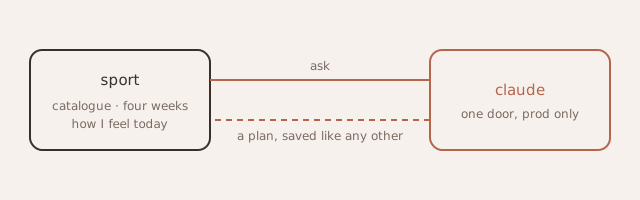
Ask claude: the catalogue, the last four weeks and how he feels go out; a plan in the app’s own lines comes back and is saved like any other.
The door is one place in the backend that every app will share. It is on only in production, so the place where things are tried never calls out.