What Selim asks, what people report from the apps, and what the company’s roles hand each other: today all three became the same thing, a to-do in Todarch, in someone’s hands.
a hub that shows what it lacks
Selim wants Todarch to be the company’s hub, where agents, roles and the people using the apps all land in one pool. And if a flow does not fit, that is a finding: “if all of this is not working, that means todarch is missing something and it’s going to help us discover.”
Two studies, run in parallel, found what was missing. Feedback had come in through a second door built just for it, and had grown its own shape inside Todarch: stages, apps, hidden details. One report gave four different answers to where is it? And the roles could not take part: Todarch knew only Selim, the assistant and a session as hands, could not tell which role was calling, and no role could move its own to-do along.
every role has hands
Now each of the company’s sixteen roles is a given value of the hands face, added when a role is hired. Every write says which role is writing. A role can hand a to-do on to another role, or stand beside one, and move what it holds along. Done and let go stay Selim’s. Every change of state, hands or needs is kept in a history of moves, so under a to-do’s name Mosaic can say “in the developer’s hands since monday”, in the role’s own colour. Every role of the company now starts its day by reading its own hands.
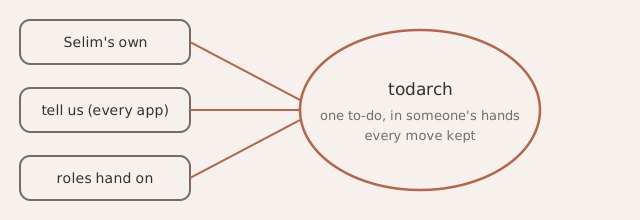
Three ways in, one pool: Selim’s own to-dos, reports from the feedback button in every app, and work the roles hand each other.
a report is just a to-do
A report is now an ordinary to-do that came in through the feedback button, the same door agents use. It holds who sent it, its app as a project, and the capture as one note. Every to-do got a short number of its own and a list of links, and the old reports keep their numbers as aliases, so “pick up 40” works whatever app a to-do came from. The old reports were moved into the new shape; where Selim had set something by hand, the move kept what he set over what the old code wrote. The old Notion table was marked out of use. Selim cut the plan down himself: “just marking the table as deprecated is good enough.”
every app can be told
The shared library got a headless report kit: it remembers the last errors, works out where a report was made, keeps the draft and sends it to the one door. Every context cube gets a last part, tell us. The kit says no word and draws no sheet; each app brings its own. Cubes, Anlat and Mosaic took it the same day, and the button now shows for everyone, not only Selim. A report names the screen and the key of what was held, never what a person wrote.
Anlat gave it its own voice. The suggested words, “tell us something”, are a command, and Anlat never commands. So the tap is written in the person’s own voice instead: “size bir şey söylemek istiyorum”, I want to tell you something. Its sheet says plainly who reads it, and that moments never go with it.
five threads, one contract
Five threads built this at once on the same code. The first thing each did was write down its contract, field names, endpoints and the order of the database changes, and send it to the others, who built against it before it existed. Then one session held the order to production: each database change only after the previous one was live, the backend before the screens. Twice GitHub showed a conflict that was not there; a fresh pull request with the same content got through. One branch had quietly pulled in unfinished work from elsewhere, and went in as one clean change instead. By the end of the morning it was all in production.