Yesterday the grouped home reached Mosaic (only the person knows). Today Selim lived in it, and it became the home.
a fixed tile and a free one
Using it on his phone, Selim found what the grouped home gives him. The app’s own tile, with its apps and tabs, never moves: a navigation he can trust. His own groups beside it move however he likes. “I love this because it gives stability and flexibility at the same time.” He named it as a rule for cube design: “the first cube is going to be the fixed one. it’s like kind of giving us a navigation.”
What calmed him was a fear that did not come true. He had worried about losing a tab after carrying it out of the kitchen app. But a given thing never leaves its place; carrying it only stands it somewhere else too. So he made the grouped home Mosaic’s home. The cube home of 1 November did not go away: it is now “the previous home”, one more way in. Nothing is thrown away.
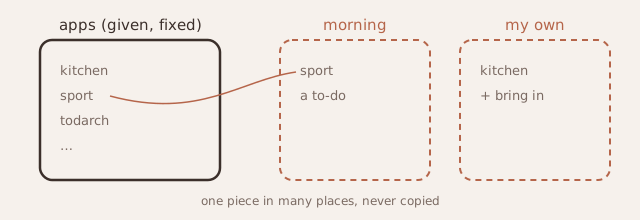
The app’s given tile stays where it was given; the person’s own groups beside it move freely, and a piece can stand in both.
bringing things in without leaving
He found he had to leave a group to bring anything into it. A study played three ways, and he picked the one he had not expected to like: the plus opens a small level of its own, “that is fitting the cube design even more”. First, bring things in: walk the home and stand any piece here too. Then the plus for a new group, which asks only a name, the way a variable starts with a name. On the way he found a new kind of cube: “there are things that app is doing, and they can still be presented in a cube design way.” Hold and order puts a piece before another; the apps stay first.
room, not a billboard
An empty group showed one add tile as wide as the screen. “This single add looks ridiculous … and it’s too big.” The square’s rule, the smallest square that holds the parts, was made for faces that grow; at zero parts it turns an invitation into a billboard. Now an empty group gets a square of places by the room it has, add first and the rest dashed. When that square ran below a short desktop window, the square learned to measure where it starts on the page instead of guessing.
the library first
On his phone the home showed five columns of small cubes without names. The cause: the home drew its own copy of a piece the library already had. Selim: “whenever there is a solution in the library … we should make use of it. Otherwise … we are solving a problem, and then it’s coming out in other place.” The small gap that made the copy necessary was filled in the library, and the home moved back onto it. He also asked that every front-end study say whether its answer can live in the library, “once we solve a thing, we can make it available for every other application.”