In the key became a door cube design was split into three problems, and grouping was solved alone. The same evening the other two were built on top of it, and grouping left the prototype for a real app.
a sign, not a guess
The earlier rounds had let things that sit side by side share a shape by themselves. That is what broke grouping: on Mosaic’s home, the apps standing beside a few to-dos look exactly like alike to-dos. A machine cannot tell the two apart. Only the person can.
So the second problem, things that share a shape, now waits for one sign. Hold a group, open its parts, say these are items of one kind, and from then on what one to-do is asked (its status) every to-do is asked, each with its own answer. The layout came from Selim’s own walk through the grouping prototype: “the first tile could be to hold the items and the rest can be just grouping in any way.”
Then a small surprise. Answering turned out to be grouping too: a to-do standing in done is the same move as morning holding coffee. Sixteen new use cases hold, and grouping’s twenty-four still hold with none broken. The old cases where siblings shared by themselves still break, on purpose; their twins with the sign hold.
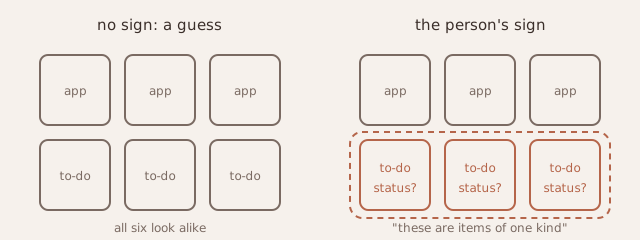
Without a sign, apps beside to-dos look alike. With the person’s sign, the shape is shared only where they said so.
offer, never place
The third problem, finding the shape while adding, was played in Anlat’s moments. When with whom is written in one moment, the other moments show it dashed, offered. Answer it once and the moments become one kind, and the question is asked of each. The cube helps without commanding: it offers and never places.
Selim’s rule from the same evening, that the top of an app is a lobby where only grouping happens, turned out to protect this too. With it, no case is left breaking in shape or in discovery.
from prototype to Mosaic
Selim wanted to “get my hands on them and play with it”: the grouping prototype and the backend’s new cube kit, both from the last two days, together in one real use case. A plan handed the build to a fresh session, so the busy one could stop growing. The plan itself was decided through eight choice cards in a row (“no name, just mosaic”, “yes, the top is a piece”).
Four agents then built it side by side. The result is a screen in Mosaic: the app’s own apps, tabs and sites are given pieces that never leave their place, and Selim’s own groups stand beside them, a piece in many places, never copied. The use-case runner played the prototype’s journeys against the real app and found three breaks every unit test had missed, two of them races where a reload undid a write. The gate was the prototype’s own result, met three runs in a row, and the screen reached production the same evening.