Every round of prototypes fixed one thing and broke another. Today the question changed: what if they were never one problem?
a key that became a door
Selim put it in a picture. “We are looking for a key. And our key became a door. And we are going to have to find a new key.” Each round had found a rule that opened one problem, then switched it on everywhere, where it got in the way of a problem it was never made for.
The use cases kept from the last days made this visible. Sorted by problem instead of by prototype, the numbers split in two: the prototypes that hold grouping (18 of 21 cases) hold no shape, and the sibling rules that opened the shape break grouping. Three problems had been tangled into one:
- grouping what is given: the home of Mosaic, with apps and tabs that belong to the app, and a “morning” group of my own beside them
- things that share a shape: to-dos that all have a status
- finding the shape while adding: a moment in Anlat that grows its own fields as you write
The proposal was to solve them in that order, and to keep each one green while the next is worked on.
given things stay where they were given
Grouping came first, on its own. The small prototype of Mosaic’s home does nothing else. What the app makes is given: it never leaves its place and takes nothing inside. What I make is a group, so dropping onto my group means inside, and dropping onto a given thing means together. That was the idea the earlier rounds were missing, and with it the two meanings of one drop stopped fighting each other.
All 19 grouping cases hold, and none break. The ground stays green for the next problem to stand on.
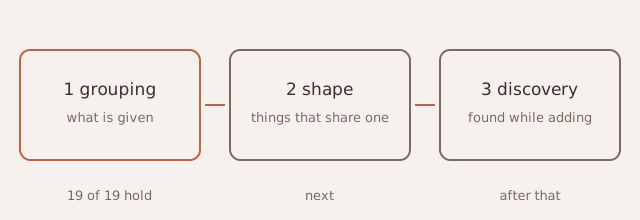
Three problems, solved in order. Each one stays green while the next is worked on.
a real finger
Playing the cases on a headless phone is one thing; a real drag is another. On the phone, the tiles moved under the finger, because the hint text grew the page while the finger was down. The hint now floats at the bottom and the page stays still. Only a real drag found it.