The Sunday cleaning (without the history) asked what the repos should keep. A second question came with it: how do we know the code in them is good, when agents write almost all of it?
a word is not evidence
A thread ran every code repo’s own checks on Cubes, Anlat and both halves of Mosaic: lint, formatting, a production build, the unit tests, a search for dead code, and an audit of the packages. Then it compared the way of working with what teams do elsewhere when agents write most of the code.
The picture was better than feared and worse in one place. The branches were tidy, there were no open pull requests, Cubes and Anlat were green. But on the front ends, a pull request was checked only by the regression cases, and Mosaic’s front end carried seventeen unit tests marked as known to fail. An agent had written I ran the checks often enough; nobody had made a machine say it.
That is the idea of the day. In a repo where agents do the work, an agent’s word that it ran the checks is not evidence. The machine has to check, every time, where everyone can see it.
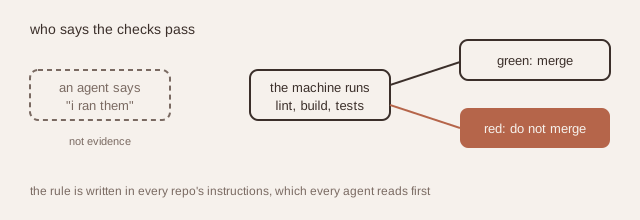
A pull request in an agent-built repo: the machine runs the checks, and a red one stops the merge by rule.
the rule lives in the words
The checks could have been locked into GitHub’s merge button. Selim chose otherwise for now: “So the check, we’re gonna have it as a rule. If the check is red, we’re not going ahead.” Agents are the ones pressing merge, and agents read their repo’s instructions every session, so the discipline can live in those words. Every repo now says it in one line: a red check means do not merge.
The same evening a second thread made it true. Cubes, Anlat and Mosaic’s front end got a checks workflow on every pull request. The seventeen failing tests turned green with none deleted. They had only four causes, and one stale mock alone broke fourteen of them.
instructions, not a diary
The study found one more thing, and it belongs to the same cleaning. Half or
more of all commits had edited a CLAUDE.md, the file an agent reads whole
before it starts. The files had grown into history books, and the thread
itself began by reading dozens of kilobytes of them. Every root file was cut
to a few kilobytes, with a check that fails when one grows past its size.
Mosaic’s four longest folder files were rewritten to half.
Rewriting found what history had hidden: a count of old components that was four times too high, exceptions that no longer existed. Short words are cheaper to read, and they are also more often true.
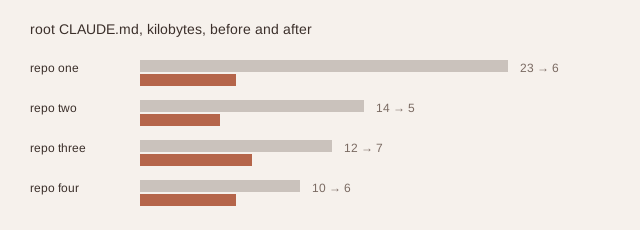
The root CLAUDE.md of four repos, before and after: the first row of a weekly history.
A Sunday task now runs the same scorecard every week and keeps its rows, so the next cleaning starts from a number instead of a feeling.