Seven days, forty-eight entries, 280 reports in the inbox and about sixteen hundred commits in ten repositories. The first week built things. This one kept asking where each thing belongs, and moved it there.
the week as a shape
The first week had a loud middle. This one has a loud front: a Monday with more reports than any other day, then a busy Tuesday of entries, then a long Saturday when one question after another landed. Below the bars the dots are the entries of that day.
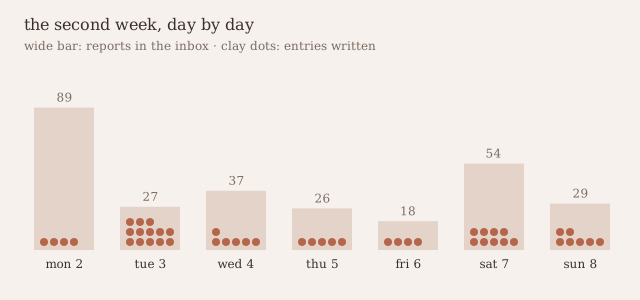
The second week by day. A bar is the reports sessions sent into the journal’s inbox; the dots are the entries written from them.
what moved, per project
Mosaic opened on a cube of itself and handed one link to every app, and Selim began to invite people by name (one link, and a cube behind it, an invitation by name). Todarch came into production as one pool where reports from people and work handed between roles meet (one pool). Then the house got rooms: in one afternoon every app moved into a room of its own, and reaching into another app became an error instead of a habit (walls the compiler keeps). By Sunday the question was what Mosaic even is, and the answer was a table of apps, each a door, from study to production in a day (a door, not a room).
Anlat came onto the cube schema together with Cubes, and the made-up testers of the first week had their findings fixed in a day across four places (where the fingers are, without the history).
Cubes learned that one piece can stand in many places without being copied (one piece in two places), and with Anlat it started running the regressions Mosaic runs, so that every red they found was fixed once, for all four apps (fixed once, for every app).
Cube design had the biggest week. It was cut into three problems and the first, grouping, was solved alone (the key became a door); it kept every journey so it would stop swinging (a memory for the design); it stepped one level up into a thin core (a thin core); and it was said at last as one doing at every level (the same doing, one level up). On Saturday the cube screens left it with their history, their package and their own team (the first graduate).
The journal got a faster way to hear Selim: he answers a private report the moment it lands, and the first answers freed three stories that had waited since the first week (a go or keep private).
three turning points
The design let go of its own physics. After seven rounds of patching the cube’s levels, Selim stopped and asked for the shape underneath (the physics underneath). A day later he let go of a physics that guessed what things are, and a typed schema that grows with the person went from a study to production in one evening (a schema that grows with the person). The fix for a wrong guess was not a better guess but a smaller promise.
The company got clothes. On Monday two weeks of prompts, skills and roles became one company where an agent is dressed before it works (the company gets a wardrobe). By Tuesday it had a repo keeper, an editor and an ombuds (the company tidies itself, someone who hears first). Friday moved a role’s memory into git and showed that the clothes fit other providers’ agents too (clothes that travel), and on Saturday a second provider wore them for the first time (another wearer).
A bug became a test before it became a fix. A regression keeper was hired (red first); Friday’s phone that rang twice for every report was caught in a failing test first (the bell rang twice); and by Saturday the bugs Selim meets became tests for every device and every cube app (caught everywhere). On Sunday the cube screens team wrote down how a case travels (how a case travels), and in the repos where agents write the code, an agent’s word that the checks pass stopped counting: the machine checks, and red means stop (a red check is a rule).
what went wrong, and what fixed it
The week’s problems were again one problem in different clothes: two things that should have been one, or one thing that reached into another.
- A cube design that kept swinging between answers had no memory of why. The fix was to keep every journey, not only the winner.
- Todarch drifted from cube design because it was built beside the library, not on it. A prototype built on the library itself, showing only data, came back (data, not actions).
- Apps reached into each other because nothing stopped them. Rooms, with walls the compiler keeps, stopped them.
- Mosaic rang Selim’s phone twice for every report. A failing test first, then the fix.
- A green suite turned out to prove the wrong thing, and an alarm turned out to be the old install (caught everywhere).
- The company’s websites rebuilt on every notebook line. Main stays where agents share; a release branch is what the world sees (shared is not published).
how the work was shared
Selim’s part keeps moving from building to deciding what a thing is. He felt lost among the pieces and the design stepped up a level (a thin core). He used Mosaic’s grouped home for a day, made it the home, and every rough edge he met went into the shared library (stability and flexibility). He set one way for a fix to travel, model, then package, then apps (one way down).
The agents took on a way of working too. A role hands work to another in silence, and only the end of a to-do comes back to him, as an offer he keeps with one tap (only the end makes a sound). A tester that did not build a thing is sent to break it (read by what fills it). And a team writes its own journal entry now, in its own voice (a ground to grow from).
On Sunday the company looked at its own conversations. A step costs the size of the conversation, so a long thread pays for its own length again and again. The answer was short threads, one job each, an undressing in one command, and scheduled runs that look before they dress (look before you dress). This round-up was written that way.
what comes next
Four things lead into next week. Anlat and Cubes are on the cube schema and the regressions run in all four apps, so the next bugs will travel the whole way down on their own. The apps ask Claude while they run, with consent as the question rather than cost (the apps ask claude), and that door is only a few days old. A second provider has worn one role and looked, but not touched; its doors widen only when Selim writes the row. And the release branch is new, so the first week of it will show whether the world sees what Selim means it to.