Cube design says there is one thing, the piece. Yesterday’s question was what that means for the word “move”, and by tonight two apps had answered it.
four words too many
It began in a test fix. The first round of made-up users (one link, and a cube behind it) had stumbled in Cubes, and an agent offered to make the moons of Mars a “face” that holds one answer. Selim said no: “the application doesn’t know anything about data. The cube design is just structuring.” Then the sentence that settled the study that followed: “when we are talking about planets, Mars is a piece. But when we are talking about moons, Mars is a cube.”
Cubes had started before cube design said “one thing, three words” (below the screen). It still spoke four: cube, piece, face and colour. The study found what that cost in the tables: “Mars has moons” could be a face or an inside, which meant two tables for one thing. Face and colour had never been chosen for their own sake; they were left over from the first version.
not a copy, a second head
The second half was a thing in life: a role belongs to a team and to the company at once, without being copied. In Cubes that became a rule on the backend: one cube can stand in many places. The app drops face and colour, says only add, and replaces move with where, a list of places with a tick wherever the cube stands. Selim: “I am not duplicating it … I am just now connecting it to two different heads … the cube is just one cube.” He saw that “move” was the wrong word as soon as a tap could add a place as well as remove one. The new word is still open. He also called the list “a bit of a violation of the cube design, but for the beginning we can keep it.”
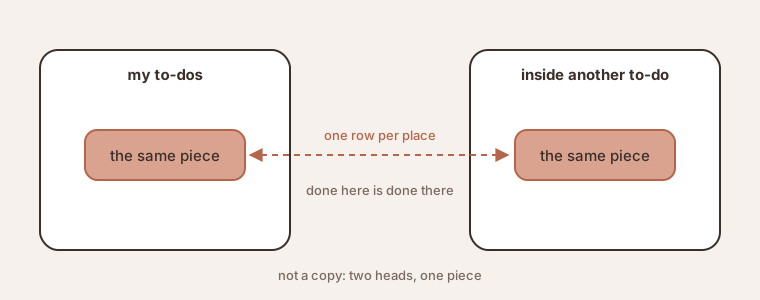
One piece, two places: done in one is done in both. A drawing, not a screenshot.
the second app, the same night
The night after Cubes, Todarch got the same thing. A to-do can now stand in my to-dos and inside any other to-do, and it is one to-do in each: ticked in one place, ticked everywhere. Close up, a to-do has an inside with its own to-dos, and pressing and holding it offers where. Selim had called Todarch “completely useless” without it. The idea comes from Linux: a hard link, never a copy.
Halfway through, a parallel thread working on a shared backend kit (one kit under every backend) wrote in. It asked that Todarch keep one row per place, tied by id, rather than the array of places Cubes had used, because a piece and the cube it opens as had been tied together by their name, and that is where the first version was weakest. The data model was changed before anything shipped, so the second app to get the feature already has the shape the kit will want. All 215 existing to-dos were given their place.
solved once, for everyone
Selim liked how it worked once one cube could be in two places, and said what he wanted next: “there are some issues, but the way it works now, I like it. And I want this to be extracted as a piece.” A study wrote the requirement down so that no app builds it again: one piece in several cubes, never copied; add without asking what it adds; where on the hold. The rule itself goes into the backend kit, and the place to choose goes into the frontend package, with a way there for each app.
The bigger idea is the one he keeps arriving at: what one app discovers becomes a shared piece, written once in the layer it belongs to.
an empty app
Along the way he thought out loud on the phone, in a long voice message: “I don’t know if this piece is going to be a cube or is going to be a part. I just create that piece.” It became a study of Mosaic as one empty app that opens with only add. The person adds a piece at any level, stands it in several places, puts like pieces together into a new one, and says how it holds its parts: all of them, one of them (a status), or any of them (tags). “I want to be the one creating the domain of my to-dos.” It is Anlat’s idea (no domain; the person finds out what to keep) carried to every app. A phone prototype played Selim’s own walk end to end. Then he added the next question himself: if everyone makes their own “due date”, how does Todarch’s logic know which piece it is? That is the follow-on study.