Mosaic’s first screen was a launcher, then a puzzle you fold with a finger, then three landing pages side by side. Since last night it is a cube of itself. Today the cube became the door to everything, and people other than Selim started walking through it.
the app is a cube
Mosaic’s menus were built before cube design. The idea for the new first screen was that the app itself is a cube: the apps are its pieces, each app is a cube of its tabs, and the same tabs can be seen from afar through other faces, by what I want to do, by which part of my life it is for, by how often I open it. A playable mock-up with Mosaic’s real fourteen apps and fifty-three tabs was ready in the evening. Laying the menu out as a cube showed something along the way: the quick-actions drawer was just one colour of one face, since wishes › add is exactly its nine shortcuts.
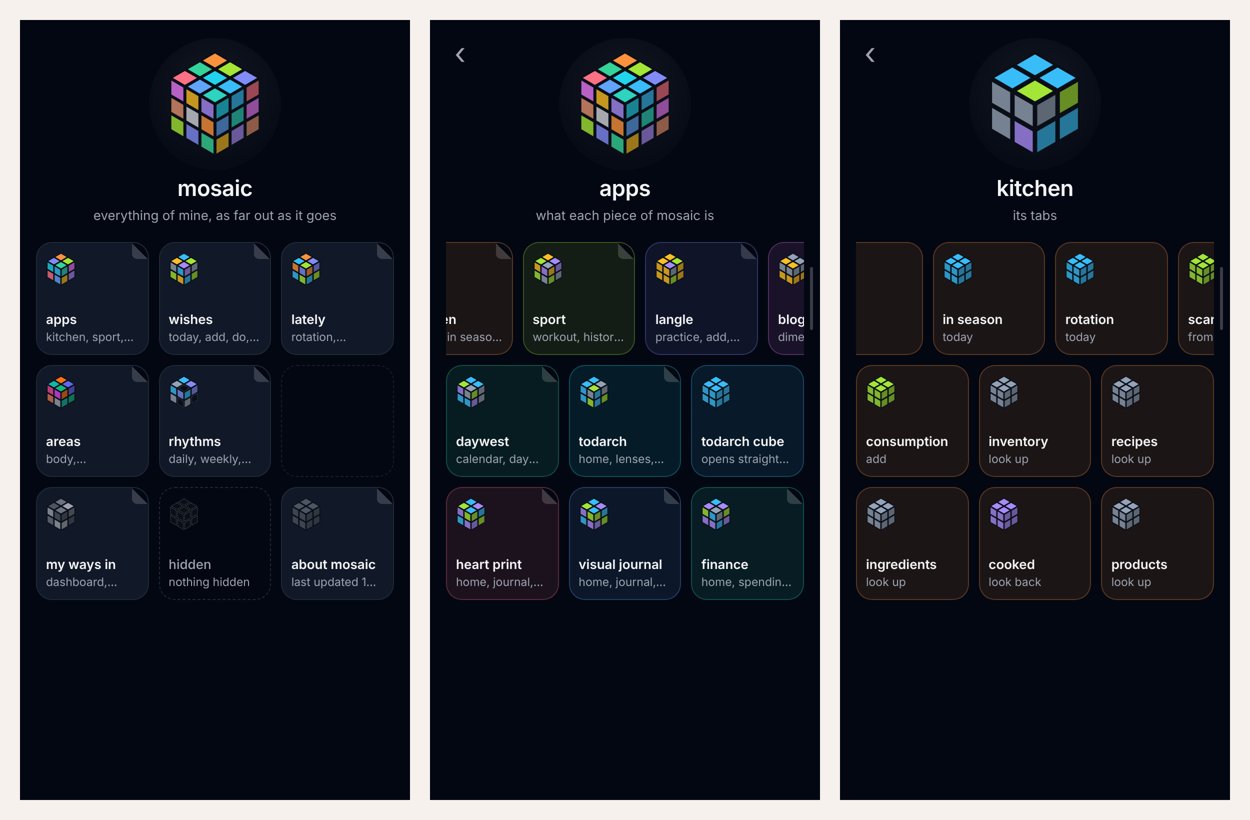
The cube home, as the playable mock-up shows it: the top, the apps face, and the kitchen’s tabs. Swiping the cube on top turns between faces (prototype, mock data).
Selim did not want the old ways in thrown away. “I don’t want to replace them… I want to offer them as options,” he said, which is cube design’s nothing found is thrown away, applied to navigation. So the dashboard, the quick actions and the puzzle stay, under my ways in, and any of them can be where Mosaic opens.
The plan was six steps. The first laid the ground: every tab now says what it is for, every app knows its areas of life and its rhythm, and a plain screen drew every level from the model so that live Mosaic never showed an empty home. Then four threads built the next steps side by side on the same files. They agreed between themselves who owns which file and what the hold is called before writing a line, and the merges were mechanical. One of them built the screens: a tap grows the next level out of its tile, back goes the way you came, and a swipe on the cube turns it. One put a press and hold on every piece, drawn by the shared library’s context cube (more on that library in below the screen). One taught Mosaic where to open and to remember lately. And one cleaned up the desktop bar, which listed every app with every tab across three rows. Selim had put it plainly: “I don’t like the desktop bar, it is too crowded. I accept this if you fix that chaos.” He was shown three options as real screenshots of the app rather than drawings, and picked one with a single tap.
A sixth thread read the other five afterwards and wrote what they learned back into cube design: two decisions, eight findings, three gaps in the library. One finding was quietly satisfying: the home’s back the way I came already built a recommendation cube design had written down on 29 October and never seen built.
Today the phone’s two drawers went. Before removing them, every entry was checked against the cube home, and three things turned out to live only in the drawers: preferences, log out, and the build line. Without the check, a phone would have been left with no way to log out. Selim’s ask was exactly that: “we don’t want to lose things… just double check it.”
one link
With the home a cube, the question was what else belongs on it. Anlat, Cubes, cube design’s site and the cube company now sit among Mosaic’s own apps for whoever has them. A tap opens the site, and Anlat and Cubes are signed in with the same personal link that Mosaic holds, handed over in the address. Selim wanted one entry point instead of remembering addresses, and one link instead of one per app. The bigger idea: Mosaic is the home of everything, and an app that lives on its own site is still a piece of it, not a separate world.
Reading the backend showed the hard part was already done. A link’s token signs in for every app of its account, whichever app the link was made for. So one link needed no backend change, only Mosaic handing its token over. A my other apps folder was considered and set aside: following alike is not a must, the outside apps stay side by side with Mosaic’s own on the faces they share.
people, a name first
Until today, adding someone to Mosaic meant asking a Claude session. Selim wanted to do it himself. The study found most of the backend already there, so the work was a prototype first and a plan second, the order he asked for.
The first prototype’s add sheet asked for everything at once. He called it a violation: “I just want to start with a name… that is enough for me to start my journey in the cube design.” And: “we are finding out how cube design offers a solution for the traditional input forms.” That became the shape. A person is a piece like any other, so adding one is a name, and everything else, their apps, their email, their link, is a part of them, walked into later. On the second version he found a toast after every filled part annoying: “the UI itself is already giving me that information.” So toasts stayed only where the screen cannot show what happened, like a copied link.
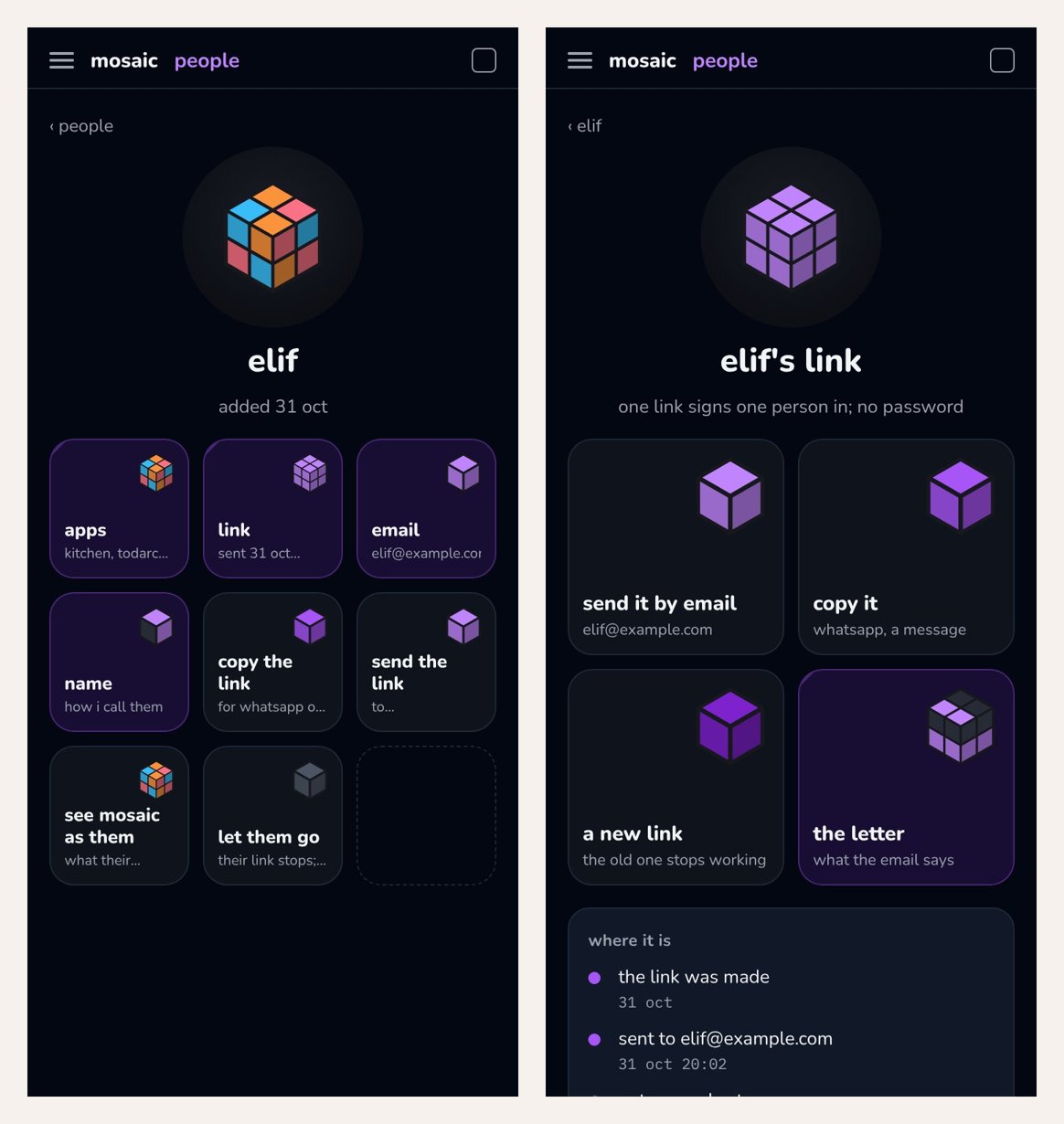
The people prototype: a person is a cube of their parts, and their link has its own level with a small story underneath (prototype, example people).
Four threads built it in one wave, agreeing migration numbers by messaging each other. Accounts got an optional email, earlier names kept on a rename, and let go, which hides and never deletes: every link ends at once, and bringing someone back leaves them without a link. Each link keeps its story, made, sent to whom, first opened, with no scores. The letter that carries a link has its wordings in a table of its own, one in use, so Selim chooses how Mosaic speaks for him without code. And see Mosaic as them builds their home from the apps open for them only, read only, under a line saying whose eyes these are.
Selim set the pace: “we are the only users of the application, so go ahead.” Everything went straight to production. When he tried sending the first link, the mail service refused, the log said only the status, and two small fixes went to production to record the reason without the link or the address. The reason pointed at the sender, and he found the cause himself: a missing .com. After that the email went out.
The same cleaning pass moved his heart print entries, his visual journal entries with their photos, and the thoughts he had written himself into the journal’s inbox, into Anlat’s moments, each tagged with where it came from. Anlat takes over what those two apps did, and fewer apps is the point. He put the data first: “the most important is to make sure the data that I created… is not going anywhere.” Retiring the old apps waits for his check.
made-up guests at the door
Then the apps were tried by people who had never seen them. Selim asked for “a plan that we can delegate to different agents, they can run in parallel … at the end of the day an input for our next piece of work.” Anlat had done this since 29 October with an AI playing one person on a simulated phone (a stranger at the door). Now it was one round across Anlat, Cubes, Mosaic, cube design’s website and the one link between them, six lanes at once, two made-up people per app on two phones side by side, always on mocks and never on the real data.
The findings rhyme. In Cubes, both testers read added by selim on things they had just added and concluded that someone else could see their private cube. The backend credits Selim for every save, whoever is signed in. The person who walked from Mosaic into Anlat and Cubes with one link found the hand-over itself invisible, one tap and she was greeted by name, and then lost her trust in the same way: in Cubes her leeks were added by selim, and in Anlat nothing told her who reads her moments, so she softened what she wrote. In her words: “one clear line: only you can see this. that’s what decides if i use it.” In Mosaic, the first mock had seeded every new account with history, and one guest decided he was reading his mate’s diary; the mock was corrected against the real backend and both guests were run again.
Anlat’s lane had a repeat visitor. Graham, the made-up sixty-one-year-old from the second persona test three days ago, came back. That test had been the first to show that the drawn cube’s trouble was gone and that both testers named side by side, two people’s moments next to each other, as the best moment. Three days later, four of his problems were gone, and four had come back. Side by side was everyone’s best moment again. The personas are English speakers now, by Selim’s rule, which surfaced things only an English speaker meets, such as share implying an audience.
Each lane left its findings in one file with a severity, so the round can be run again after the fixes. Mosaic reaching other people is no longer a question of accounts and links. It is a question of one clear line on the screen.