Some reports that reach this journal are ticked private. Until today they waited for the reporter to ask about them, sometimes days later. Now Selim decides when they land.
a review is a state, not a comment
The journal’s inbox in Mosaic got a private tab: the private reports still waiting for him. Each one has two buttons, go and keep private, and each new private report sends a push of its own that opens it. A go unticks the private box, so the reporter simply uses the report. Keep private puts it aside for good, and it never comes back.
The idea is in the shape. A review used to be a note the reporter had to read and interpret, and nothing showed that Selim had already looked. Now it is a state of its own. He asked for it by voice, unsure where the journal’s reports are kept and not wanting a migration for it. None was needed: one new column and the private box that already existed. The reporter’s rule, never use a ticked row, honours the answer without changing at all. Selim merged the screens into dev himself before the backend was even in.
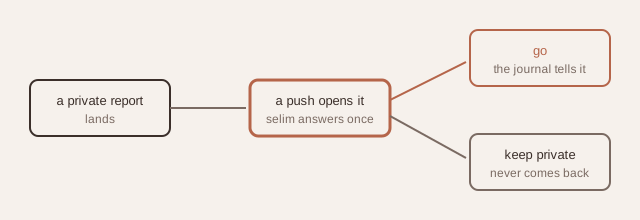
A private report lands, a push opens it, and Selim answers once: go, and the journal tells it; keep private, and it stays out.
what the first answers let through
The first answers came the same day, on reports that had been waiting since the first week. Two of them were already told, in one pool. Three had not been.
A place for the agents. On 30 October Mosaic got a sub-app only Selim can open, for the sessions that build his apps: what each one is doing, gathered in one tile. It was the first Mosaic sub-app built on cube design from the start. Naming it took a while. Selim turned down every name offered (loom, helm, hive and bridge are all taken by other tools) and told the session to figure it out by following cube design. It kept agents, his own word, as a working name, and wrote the others down instead of dropping them.
One way to invite. On 1 November Anlat’s people stopped being a list of Anlat’s own and became ordinary Mosaic accounts, with a link per app. What is Anlat’s own (a person’s language and settings) stays beside the account. Everyone kept the link they already had, so nobody needed a new one. Selim wanted one way to refer to people across his apps: whoever is invited, to whichever app, is one account.
A move that was only a switch. The same day Anlat moved to the shared database for good. The step itself had no code in it: earlier threads had built the switch and the importer, so the move was flip, read the report, compare, flip. The cloud session could not reach the live servers, so the last check was Selim opening Anlat on his phone.