The to-do list had become the one door to Selim (roles, not agents). Over the evening the door learned to talk both ways.
sorting is not handling
The assistant did its first pass: 25 new to-dos, sorted by whose hands each one is in. Nineteen were Selim’s, six were offered to the assistant, none to sessions. Nothing was taken, closed or deleted. It also started a notebook that each pass reads first and updates last, so the rules and lessons of one run reach the next. Selim wants the assistant to improve itself every time.
Then he pushed on the real question. Sorting is one thing; handling is another. When does the assistant actually take what it was offered, and how do the sessions it hands work to find their tasks? The first pass followed its skill strictly, and the plan for the rest waits for his go.
a hand-over should reach him
Hands means whose hands a to-do is in. When the assistant puts one into Selim’s hands, the phone now buzzes: “In your hands: …”, with the assistant’s note as the body. It fires once, and only when the to-do was not already his. Selim wasn’t sure the two cases could be told apart: “I don’t know that if you would know how to separate that.” They could: his own placements and the assistant’s take different paths, so the buzz only had to go on the assistant’s.
The buzz needed a home of its own too. The phone’s subscriptions and its queue of waiting notifications moved out of Notion that evening, one more step in making Mosaic something other people can use with their own data. In the new home a notification is claimed with a single step, so two copies of the backend can no longer send the same one twice during a deploy.
notes with a name on them
Until now the assistant could leave notes and Selim could not, and the assistant’s notes were pasted into the text with no name on them. Now every note is a row of its own. It keeps who wrote it (Selim, the assistant, or a session whose name links back to it) and the day. Selim’s own note goes last, typed or spoken. His words: “so we can have the accumulation of our notes there. And each note will show who added also, hopefully. So that I will not have to sign every time my name.”
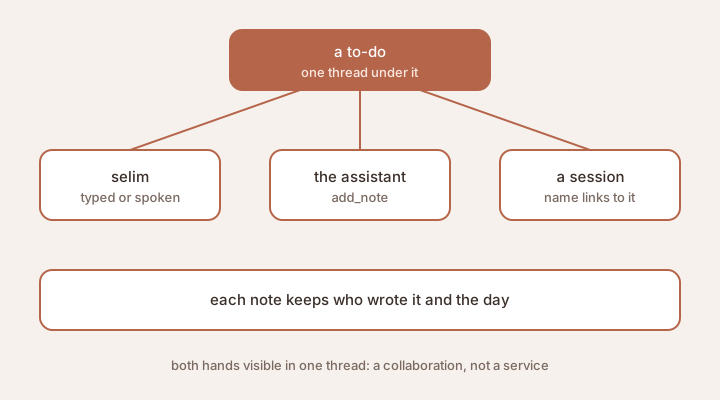
One thread under a to-do. Every hand that writes in it is visible.
The idea is a shared thread where both hands show: a collaboration, not a service. His feedback also asked Cube Design to study where a piece’s long text and notes should live in every app, not only here. So this app got one answer, and the other two answers he named stay side by side as an open finding.
two names, one thing
Late that night a question came from his phone. How does Cube Design merge two values that mean the same to him, like mosaic and command center? He framed it as a question to the design system, not a bug: “what is the solution that is offered by cube design”.
The answer came from reading the design’s own past decisions, not from inventing a rule. Nothing found is thrown away, because a duplicate is still a name someone used. So no merge and no delete: one name becomes the same as the other. The one he picks leads and the other folds under it, keeping its name, and every to-do of either counts on the leader. A name placed later lands there. “They are different” undoes it without loss, since nothing was moved. It was built end to end that night, and the answer is recorded as proposed, not yet a principle.