Four apps now follow one design, and each breaks it in its own way. Finding the breaks one screen at a time does not scale, so the design got a way to be checked.
a specification and its implementations
Cube design is a specification. Cubes, Anlat, the todarch cube and the design’s own website are implementations of it. Standards bodies check their implementations, and the same can be done here. Selim wanted something that can be run again and handed to agents, where the output of each run becomes the input of the next.
The plan borrows its words from elsewhere: conformance, assertions, heuristic evaluation, fitness functions, drift. It has verdicts, five areas (navigation, how knowledge is shown, words, actions, the app about itself), local fixture data, and three briefs for agents: a spec pass, an app pass and a synthesis. Selim leaned toward one agent doing everything. The plan splits the work instead: each app gets its own judge, and an area run, one area across all four apps by one agent, is the cheap routine check.
the design read against itself
The first thing the reading found was drift in the checker’s own copy: it was 81 commits behind. It showed 13 principles while the apps already cite principles 22 to 31. That was the first finding of the run.
Then the first pass turned the principles, moves and patterns into 81 checkable assertions and read cube design against itself.
navigation, in four apps at once
One session walked navigation in all four apps. A shared fixture world (a kitchen shelf of four pieces, a drawer of ten, a renamed paprika, a hidden piece) was mapped onto each app, and a browser harness took screenshots on a phone and a wide screen with every write blocked.
Stepping out of a screen works everywhere. On 49 inner screens, the back arrow, two fingers together and ctrl+wheel all land on the same place. The real split is two questions the spec leaves open: is back the way you came, or one step out by place? And is a face reached by turning the cube, or by going into its tile?
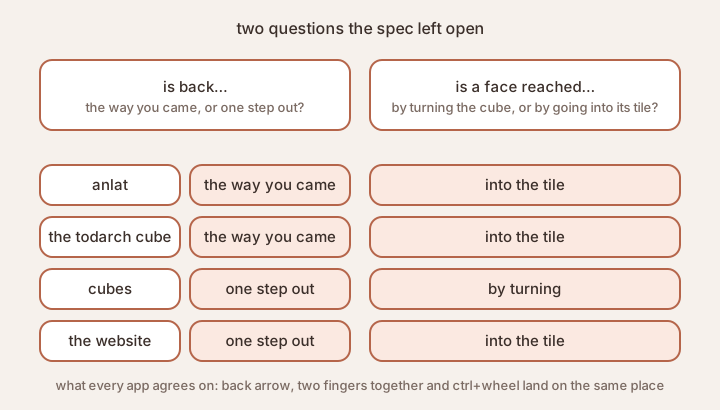
Where the four apps differ on the two open questions.
The hold menu, a principle written that same morning, exists in Cubes and is missing in the todarch cube and the website. The harness’s simulated touch hold did not trigger the holds that the code and a right click show, so those cells were judged from the code, and the reports say so.
The run produced reports and verdicts per app, a comparison, a matrix and proposals: six drafts of violations, six findings and three fix sessions. Nothing is decided by it. Selim decides.