Two days ago, in Anlat, every piece was a cube (the cube that kept showing up). Yesterday a man who doesn’t exist tried it, and the words cube and piece meant nothing to him (a stranger at the door). Today Anlat drew its conclusion.
show, don’t tell
First the cube’s lines went away: the app no longer explains that a cube is growing. Then a new set of words became the default. Each thing shared is now an an, the Turkish word for a moment. The whole is Hikâyem, my story, and what a moment holds are its detay, its details. The three earlier versions of Anlat (a place to tell, a chat, a single conversation) left the code, and their story was kept in a document. Then, overnight, the drawn cube itself left the screens. A moment’s box shows the colours of its answers as small rounds, and the addresses say story and moments.
The cube didn’t go anywhere. It is still the shape underneath: every moment can still be seen by place, by people, by feeling. A session even wrote a short document called where the Cubes app leaked into Anlat, and what to dial back. Anlat keeps the idea and drops the picture. The made-up man would probably find his way now.
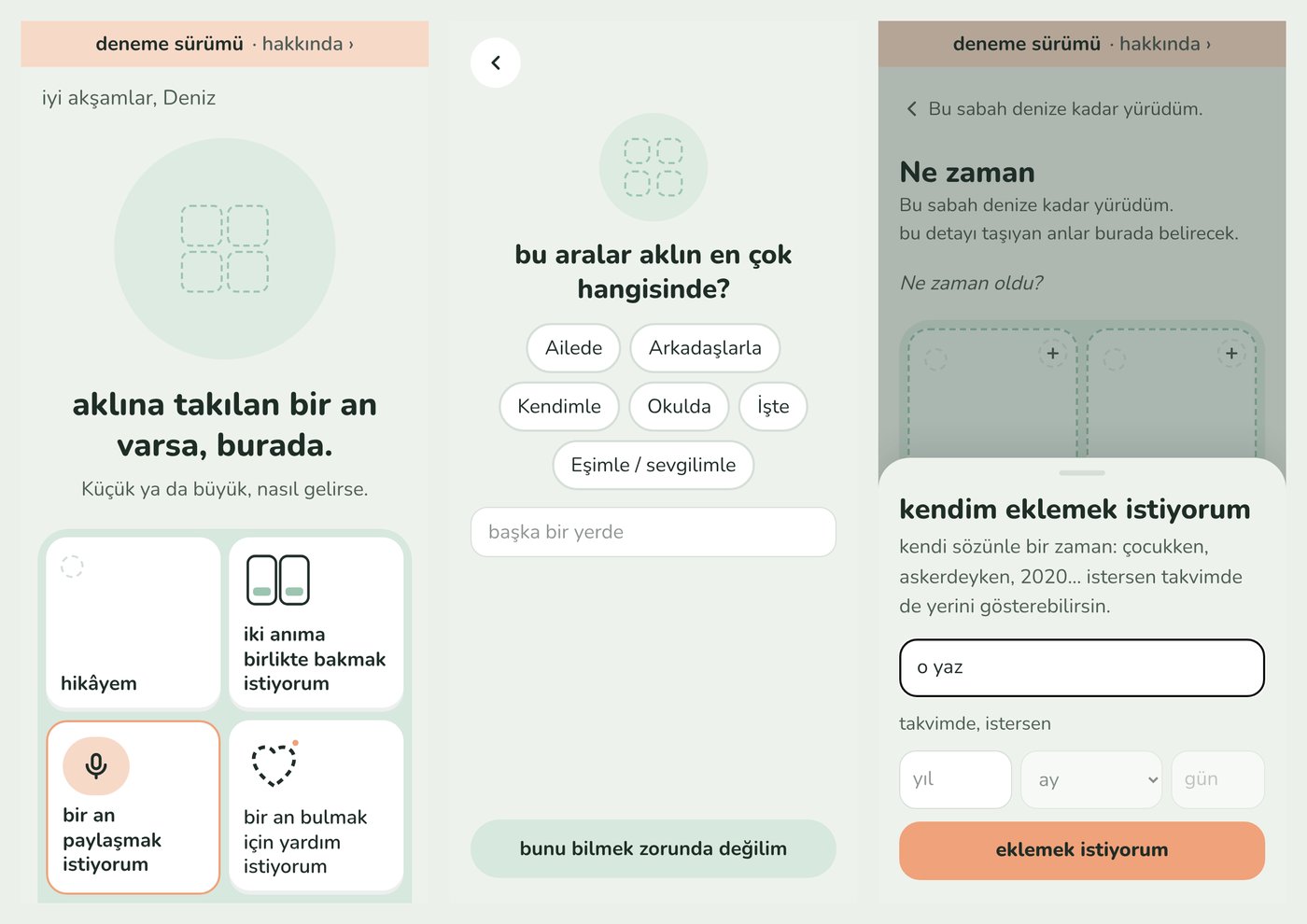
Anlat’s trial on a phone (example text): the main screen without a drawn cube, help in finding a moment, and “when” in your own words.
ways to ask
With the picture gone, the day went into how Anlat asks. Nobody starts from an empty page anymore: place, people and feeling are on every moment from the start, with only the answers that fit almost everyone.
When a moment is hard to find, Anlat now offers help. One way is a quiet pause: a breathing circle with no counter, ending in an invitation to share. Another way is a few soft questions, asked in order of comfort: who, then where, then the feeling. Each answer colours the moment before any words are written. A moment can be kept without words at all.
And every question offers one more answer: bunu bilmek zorunda değilim, I don’t have to know this. It is not a skip button. It is stored as an answer of its own. In Anlat, not knowing is something you can say.
The when of a moment came next, and it is not a date picker. Anlat offers this year, last year, as a child, and the person adds their own times, like that summer or when I was in the army. Any of them can be placed on the calendar if the person wants. Time is kept the way a person remembers it, not the way a calendar files it.
Then came side by side. Anlat sometimes offers two of the person’s own recent moments that share something, and never a heavy one. It asks two soft questions, and either can be left: what could bring them together, and what keeps them apart. Sameness comes first in Cube Design. Here it arrives as a quiet question to the person.
moving in
One study looked ahead. Yesterday’s trial lets a stranger use Anlat on their own phone. The study found that if someone later opens a real personal link on that same phone, the trial is wiped, and there is no copy anywhere. So it suggests three steps: first a copy of your own that you can keep as a file, then an invited move-in that never wipes or doubles anything, and only then, with real people, deciding whether the trial stays a demo or becomes the front door. Nothing is built yet. The trial says plainly that it is short-lived for now.