Most days the work is about screens. This morning it was about words, and it moved in four steps, each a little further than the one before.
small letters
The first step was a new Cube Design principle: an app writes its own words in small letters. That includes its name on the phone’s home screen. At first, capitals stayed for abbreviations, codes and names that belong to someone else. By evening even those names went small wherever an app says them itself: notion, claude, chrome, google. What a person types is never touched. Cube Design applied the rule to itself first, to its documents, its website and its skill, and then to the three apps. That was about three hundred files: scripts did the bulk, and then every file was checked by hand. Turkish needed its own pairs, because a capital İ becomes a small i, not an ı.
It is a rule about voice, not looks. The app speaks softly, and the person’s words keep their own shape. This journal has written its titles in small letters from the first day; the rule caught up with it.
language is its own piece
The second step: all 507 lines Anlat says moved out of the code. They now live in one copy inside the app and in a table, one row per wording, with Turkish and English side by side and a tick for the one in use. The app lays the ticked lines over its own copy. A session checked every screen, line by line, in both languages and all three word sets: nothing changed. That was the point. From now on, changing a line means ticking another wording, not making a release.
In Cube Design terms, language became a piece of its own, something that can be turned and swapped like any other.
everything is theirs
The third step used the table straight away. Anlat’s settings corner was called seninle ilgili, about you. It became benimle ilgili, about me. Şimdilik değil, not now, became vazgeçtim, I changed my mind. Yesterday Anlat had found two voices: the app offers, and the person wishes, in the first person (a stranger at the door). Then Selim went one step further. The lines of that corner stopped asking permission. No if you like, no you can: bunlar benim; istediğimde değiştiririm, these are mine, I change them when I want. Anlat’s Spirit gained a rule: everything is theirs.
and then the words had voices
Then came the turn that made it a cube. After rewriting those lines in his own unconditional voice, Selim asked to keep the old, inviting ones as well. So now Anlat speaks one language in two voices: davet eden, the inviting one, which is the default, and kendi sesim, my own voice. The person chooses between them in their preferences, where each voice says the same line. The table got a column for it.
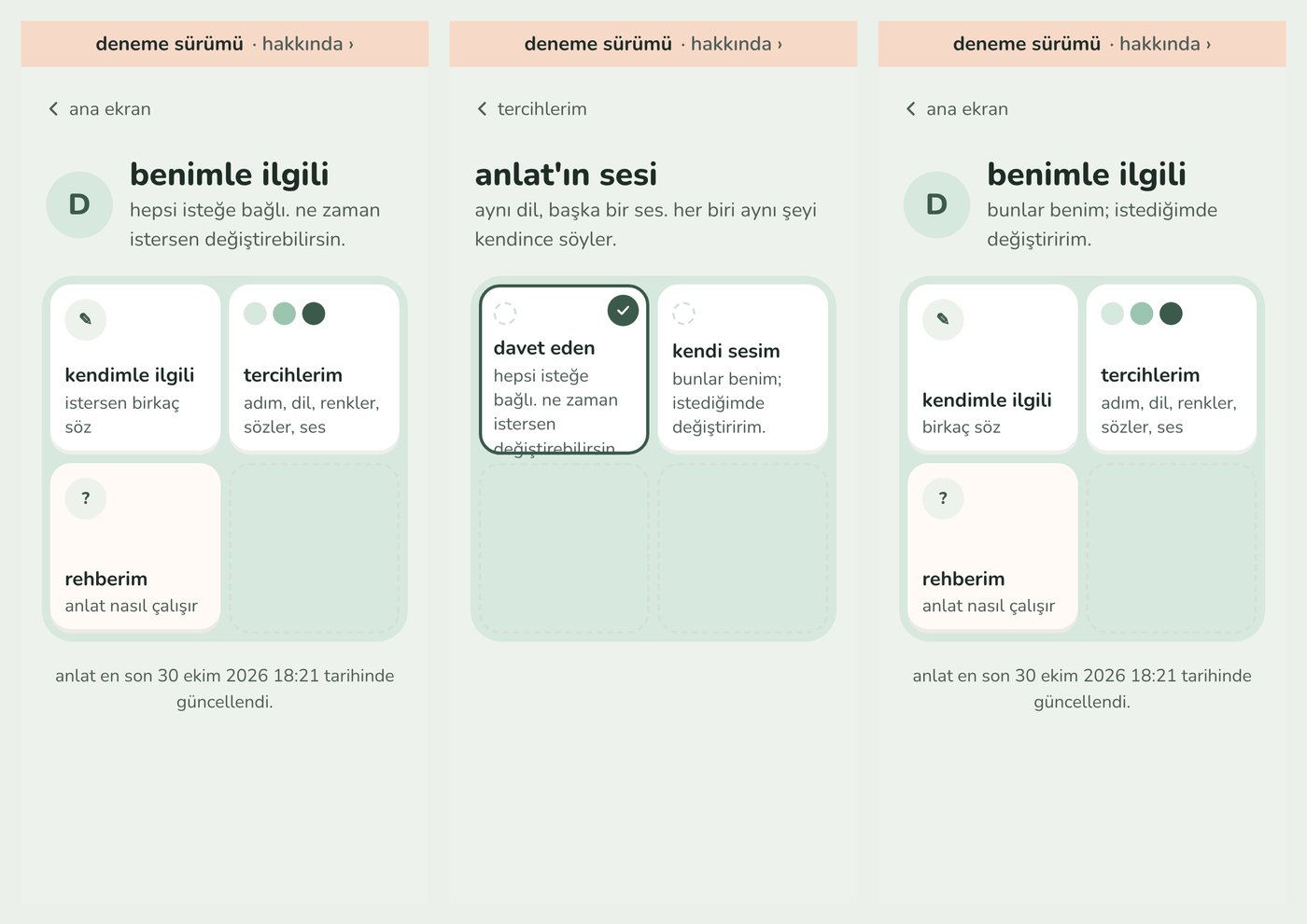
Anlat’s trial on a phone (example name): the corner about me in the inviting voice, the choice of voice, and the same corner in my own voice.
In one morning, the words got small letters, left the code, became the person’s, and turned out to have a dimension of their own. Language, word set, voice: a line is a piece with three faces.